
Can Your Phone Camera Actually Check Your Form?
Yes, for some things, and no for others. Here is exactly what a single phone camera can see about a lift, what it cannot, and why we cut a whole category of exercises because of it.
Short answer: yes for some things, no for others, and the line between them is sharper than you would expect.
A phone camera watching you lift is not looking at your body. It is looking at seventeen points on it. Shoulders, elbows, wrists, hips, knees, ankles, and a handful on your face. That is the whole picture. Everything Therox knows about your squat is derived from where those seventeen dots are, frame by frame.
Once you understand that, both the capability and the limits stop being mysterious.
What seventeen dots can tell you
Angles, mostly. If you know where a hip, a knee and an ankle are, you know the angle at the knee. Track that angle through a rep and you know how deep the squat went and when it came back up. That single idea does most of the work: depth, lockout, how much the torso is leaning, whether one arm is higher than the other, whether the bar is drifting forward.
It also gives you the rep itself. A repetition is just that angle going down and coming back through a threshold. Counting is a side effect of watching the angle, not a separate feature.
So the things a camera is genuinely good at are the things that show up as joint geometry. Depth on a squat. Lockout on a deadlift. Whether your elbows are drifting on a curl. Whether your left arm is lagging your right on a press.
What it cannot tell you, and one example that cost us a feature
The seventeen points do not include a heel. They do not include a toe.
That sounds like a footnote until you try to build a calf raise. A calf raise is your whole body rising a couple of centimetres on the balls of your feet. Without a heel point or a toe point, there is no ankle geometry to measure. What is left is a few pixels of whole body rise, which any small camera movement swamps completely. Somebody breathing near the tripod produces the same signal as a rep.
Therox had a ninth category of exercises designed for exactly this kind of movement, calf raises and shrugs together. We built it, looked at what the checks would actually be reading, and cut it before it shipped. Shipping it would have meant shipping checks that fire at random, and a check that fires at random is worse than no check, because you learn to ignore it.
There are other things outside the camera's reach, and they are worth saying plainly. It sees your body, not the bar, so it has no idea whether the weight is appropriate for you. It cannot feel pain, so a rep can pass every check and still be the rep that hurts you. And it cannot see anything that is out of frame, badly lit, or behind another person in a busy gym.
Why one camera means one angle
Here is the part people find least intuitive. A single camera sees in two dimensions. It does not know how far away anything is. So an angle is only measurable if it happens to be facing the camera.
A squat's depth lives in the plane you see from the side. Film it from the front and the knee angle flattens into almost nothing, and the depth check is reading noise. Arm symmetry on an overhead press is the opposite: it compares your left side against your right, so from the side one arm simply hides the other.
That is why every movement in Therox names its camera angle on the exercise card, before you start filming. It is not a preference. It is the difference between a check that measures something and a check that measures nothing.
Rather than guess, Therox marks a check it cannot see from where you put the phone as not judged, and says why: filmed face-on, this needs a side view. It shows a dash instead of a tick, so a check that never ran is not quietly counted as a pass.
The rep is still scored on the checks that could run, and the summary tells you how many that was.
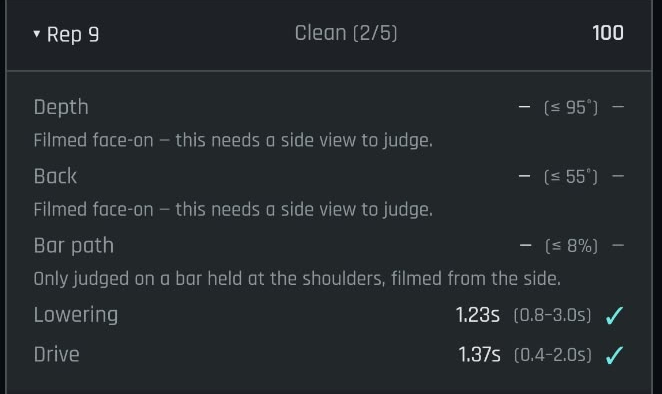
This rep scored 100. It also had only two of its five checks available, because the set was filmed face-on and depth, back angle and bar path all need a side view. That is what Clean (2 of 5) is telling you, and it is the number to read before you read the score.
Worth knowing, because a set filmed from the wrong angle still produces a score, built on whichever checks did not need that angle. Getting the framing right is what puts the rest of them back in play.
Nothing leaves your phone
All of this happens on your phone's own processor. The frames are analysed where they are captured and then discarded. No footage is uploaded, none is stored, and none is sent to a third party. What syncs to your account is the results: rep counts, form scores, check results.
That is partly a privacy position and partly an engineering one. Sending video to a server would be slower, would cost money per user, and would create a pile of extremely personal footage that somebody eventually has to be responsible for. Not collecting it is the only version of that problem we know how to solve properly.
So, can it?
For joint geometry from the right angle, in decent light, with your whole body in frame: yes, genuinely, and it will tell you what to fix while you are still lifting rather than after the set.
For anything that does not resolve into visible joint angles: no. We name those rather than fold them into a score.
If you want the specifics, Therox publishes every movement it coaches, the checks it runs, the angle each one needs, and how far those numbers have been tested so far.